Embedded Software Development for the STeaMi Board
End-of-second-year BUT R&T (cybersecurity track) internship at the LAB — Laboratoire d’Aix-périmentation et de Bidouille, focused on the STeaMi embedded board and its Bluetooth Low Energy communications.
- Context
- Internship · 2026
- Field
- Embedded & IoT
- Tools & technologies
01
Context & Host Structure
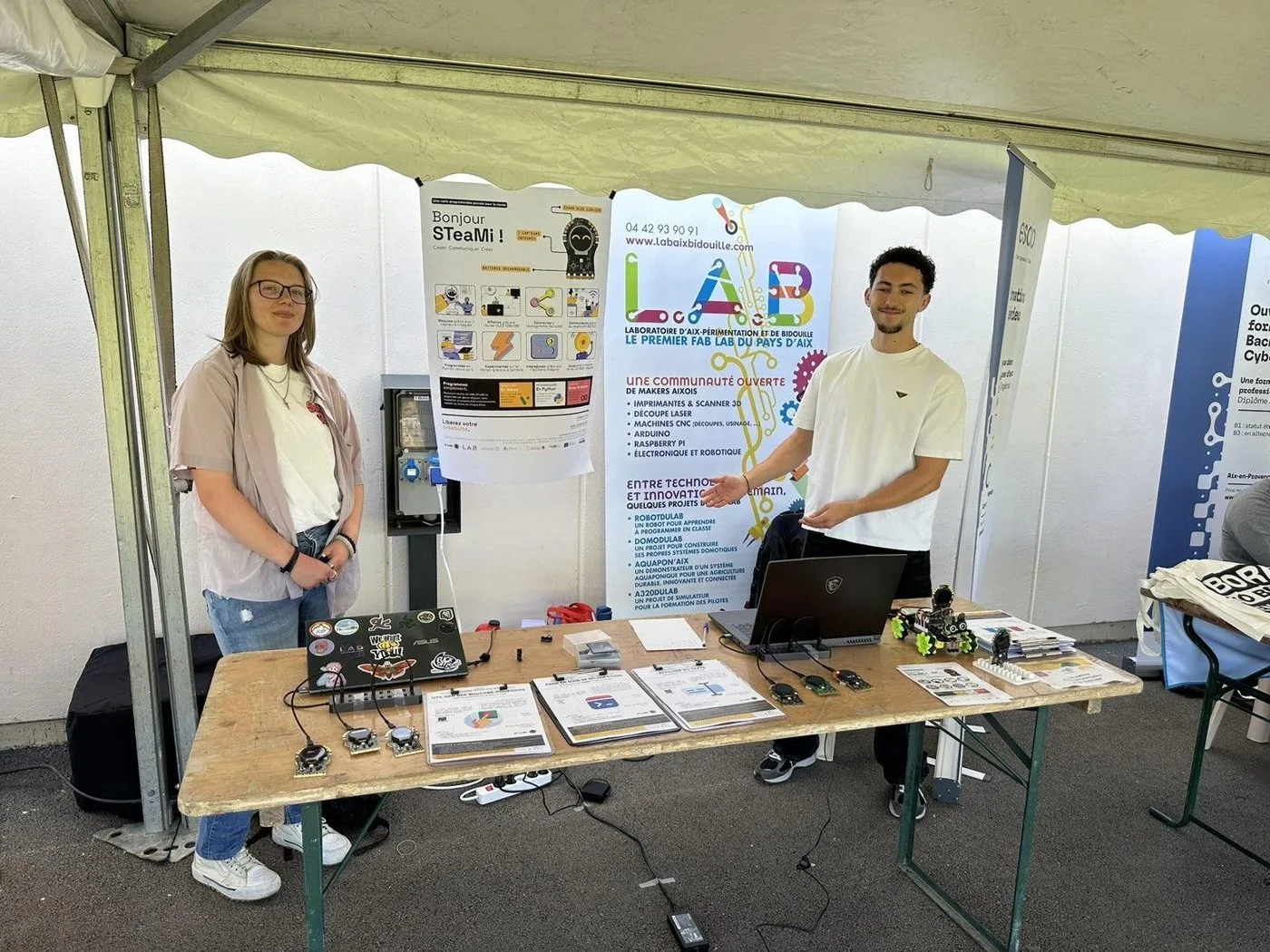
The LAB is a Fab Lab (non-profit) based in Aix-en-Provence, dedicated to maker culture, digital fabrication and science outreach. The internship took place in an open-source environment: all code was hosted on the LAB’s GitHub repositories, with my contributions tracked through issues and validated via Pull Requests.
The core mission was the development and optimisation of the STeaMi’s Bluetooth Low Energy (BLE) features: building reliable multi-board communication, implementing a trilateration positioning system, and optimising advertising/scanning to cut power use and improve network performance.
02
The STeaMi Board
A pedagogical development board designed by the LAB, built around the STM32WB55RG microcontroller. It features a circular 128×128 OLED display, several sensors (accelerometer, gyroscope, environmental sensors), touch inputs and BLE 5.2 connectivity.
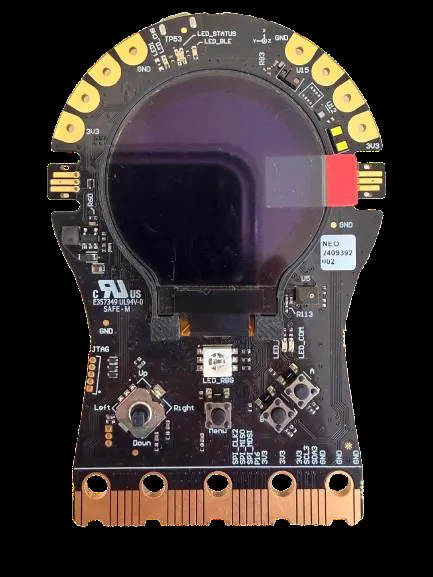
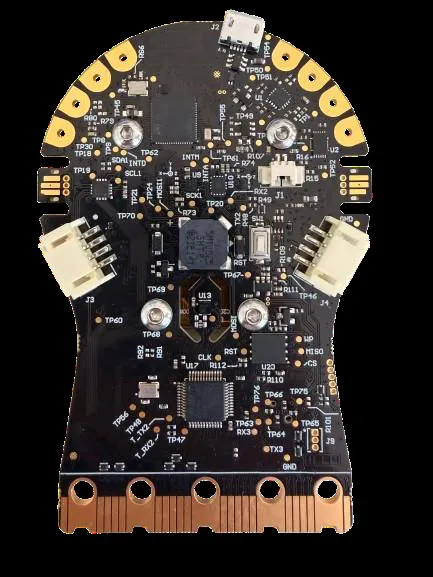
Software environment: MicroPython (fast prototyping, direct hardware access) and C++/Arduino for performance-critical parts. Tooling: Thonny, mpremote (REPL) and a Python virtual environment, all on a Debian machine.
03
Multi-Board BLE Communication
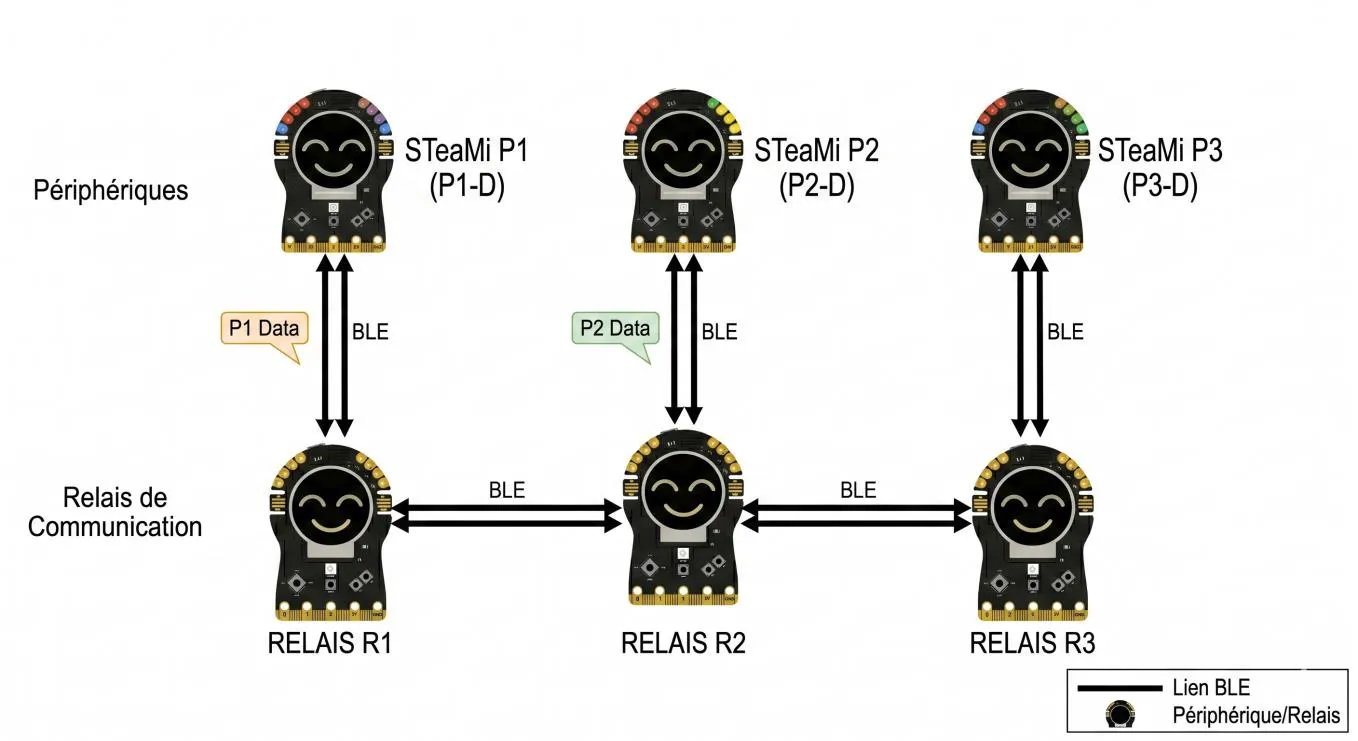
Building a BLE mesh network made of three sensor peripherals (P1–P3) and three relays (R1–R3). It works in a connectionless mode: packet advertising and scanning, without a GATT session, for lighter communication and better scalability.
- Data encapsulated in JSON frames (sender, recipient, payload, hop counter)
- Multi-hop retransmission between relays with loop avoidance (hop counter)
- XOR encryption for minimal securing of the exchanges
04
BLE Trilateration Positioning
The most accomplished part of the internship: an indoor positioning system estimating the position of a mobile board (STeaMi-Nomade) from the RSSI of three fixed BLE anchors (M1, M2, M3).
- Log-distance path-loss model to convert RSSI into distance, with manual calibration of each beacon
- 2D trilateration via the intersection of three circles centred on the anchors
- Signal filtering: moving average, exponential filtering (chosen), Kalman and particle filters tested
- OLED interface showing beacons, distances and the estimated position on a 2D map in real time
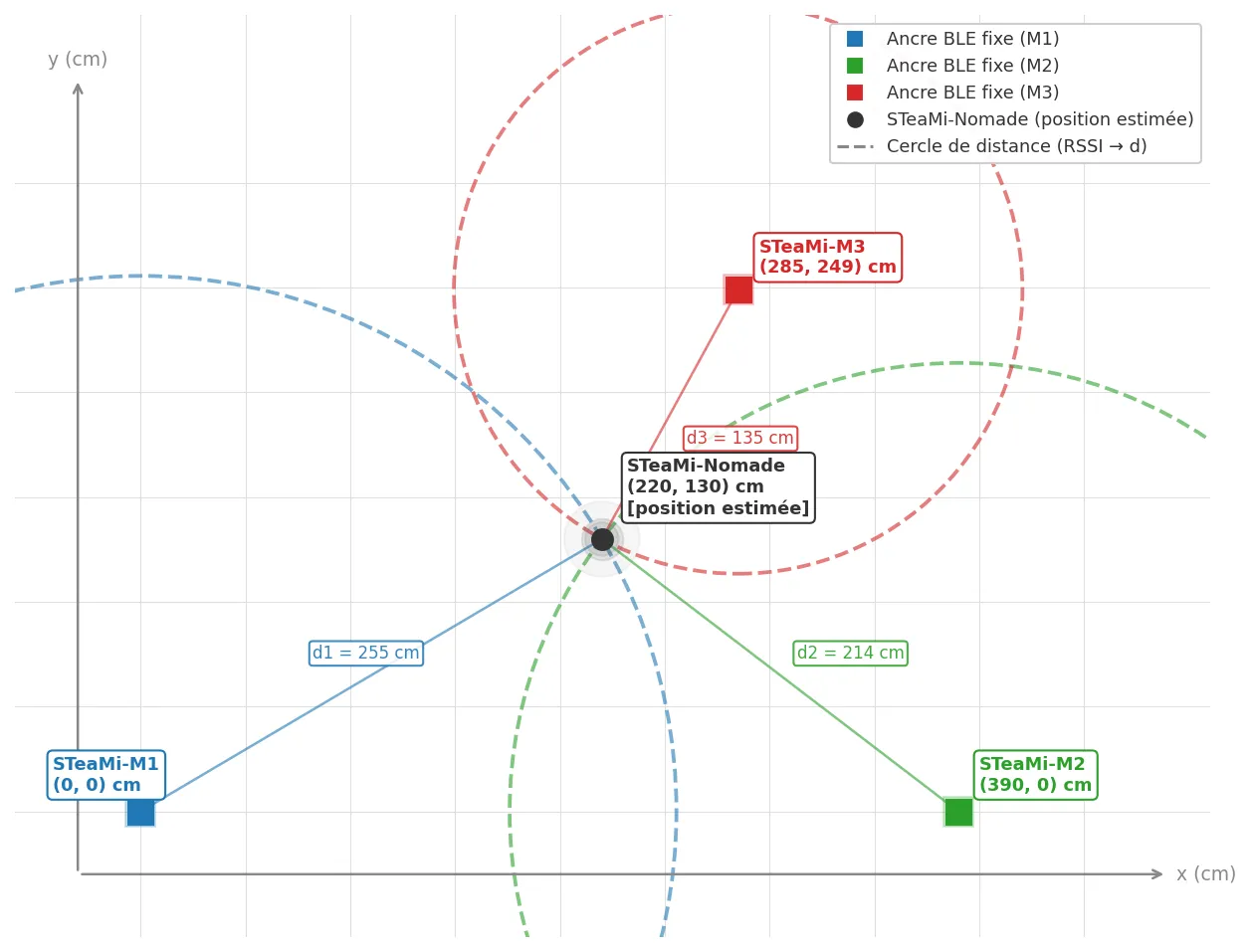
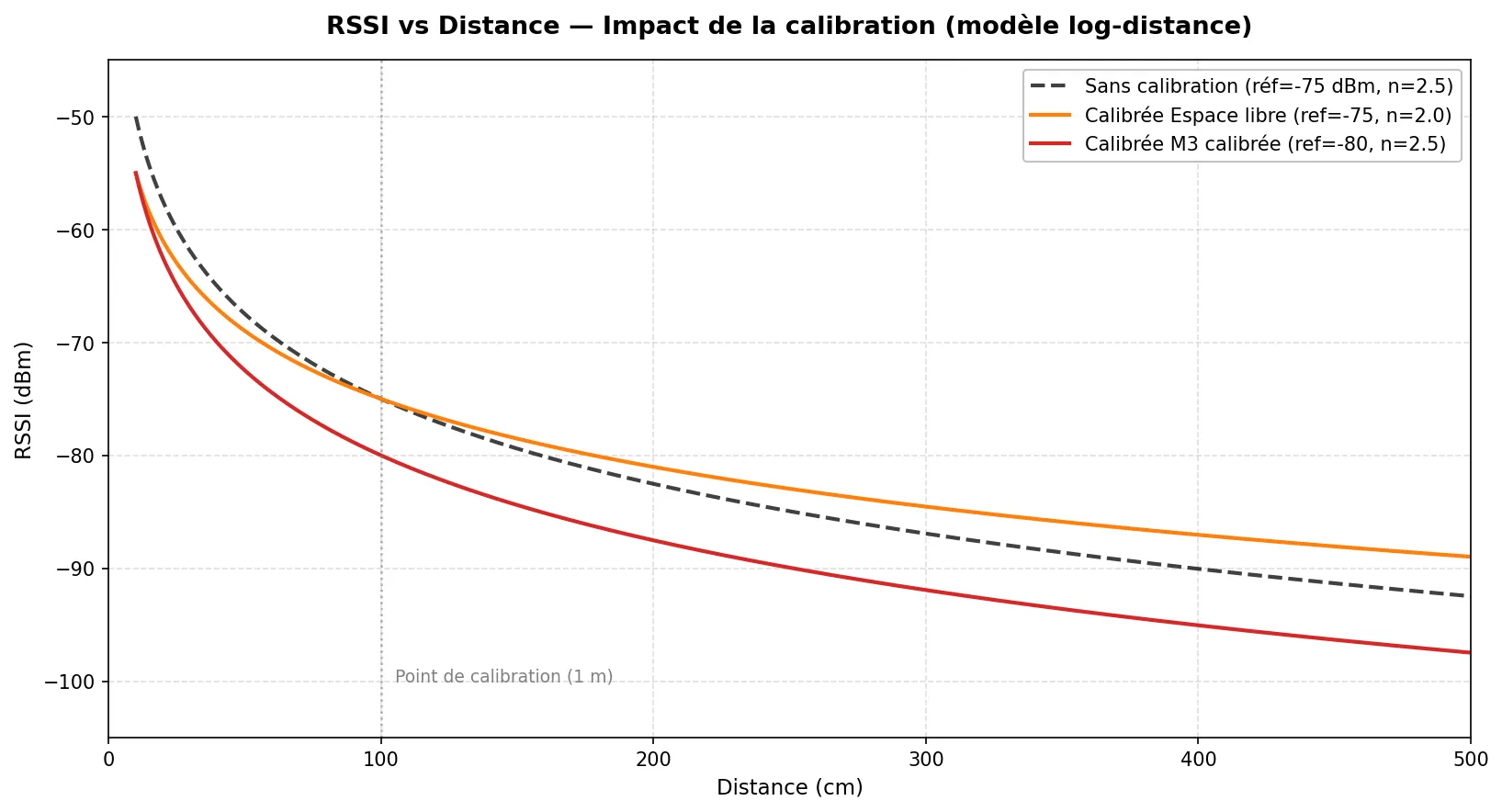
Average accuracy around 20 cm in a controlled environment under MicroPython, despite high RSSI variability and the limits of an interpreted language.
05
Optimisation & C++ Porting
To gain responsiveness and real-time stability, the critical parts of the positioning system were ported from MicroPython to C++ (compiled, low-level control). Optimisations: trimming the main loop, limiting dynamic allocations, raising the BLE computation rate and reducing acquisition-to-display latency.
Result: much faster and more stable execution, with centimetre-level accuracy in controlled conditions. OLED display remains in MicroPython for now (no SSD1327 C++ driver yet), with C++ results shown over the serial terminal.
06
Fun Project — Maze Game & Dijkstra
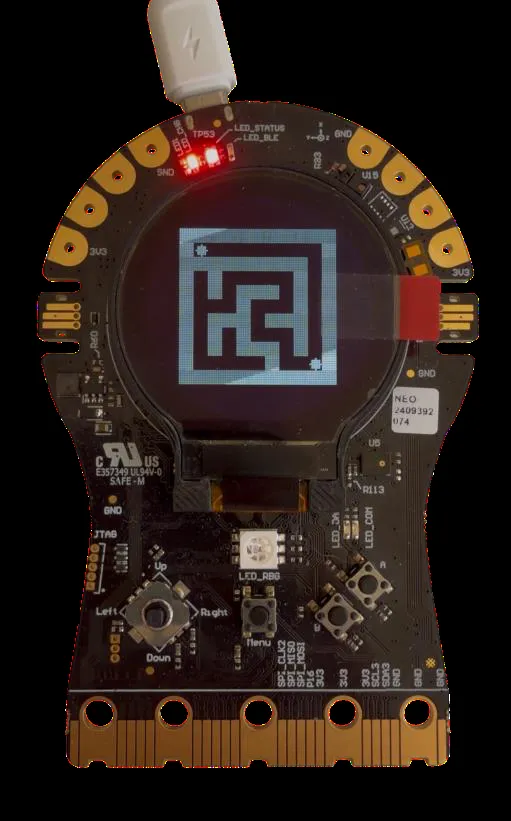
A maze game controlled by tilting the board (ISM330DL accelerometer, SSD1327 screen). The maze is generated with DFS / Recursive Backtracker; a Dijkstra algorithm computes the shortest path to score the player. Designed as a teaching resource for algorithms in NSI.
07
Educational Activities
- CE2/CM1 school workshops (Marcel Pagnol school): unplugged Scratch, parity bits, Towers of Hanoi — popularising concepts seen in BUT R&T
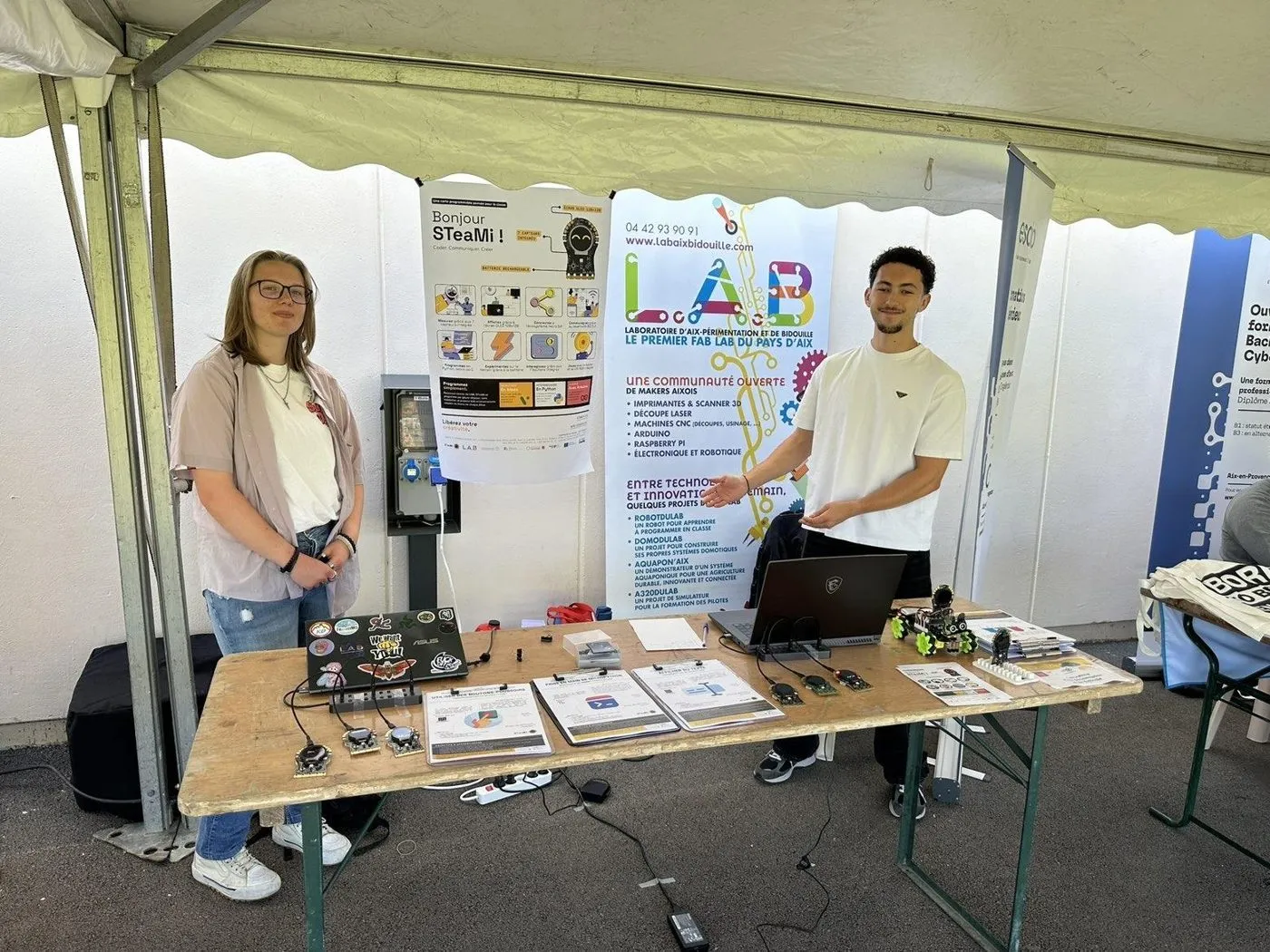
- ITER Robots day: co-running a STeaMi stand at the Marie Mauron school in Pertuis
- Educational resources (InnovMicro-EXAO #2 project): progressive wiki sheets to get started with the STeaMi
08
Skills Acquired
- Embedded Development
- MicroPython and C++/Arduino on STM32WB55, sensor handling
- BLE Communication
- Advertising, scanning, multi-hop mesh, JSON frames
- Algorithms & Signal Processing
- Trilateration, log-distance model, exponential / Kalman filtering
- Software Optimisation
- MicroPython → C++ migration, memory and real-time handling
- Open-Source Workflow
- Git/GitHub, issues, Pull Requests, collaboration
- Outreach & Teaching
- Running workshops, adapting to different audiences